


Inside TOTO’s Vision of the Modern Japanese Bathroom
7/24/2026The Bathroom as a Retreat: Inside TOTO’s Vision of the Modern Japanese Bathroom
Of all the rooms in a British home, the bathroom is the one most often designed by accident. In Japan it is designed with intent. Working with Flora Immler, the Japan specialist behind studio ukiyo, TOTO has produced a concept that translates the calm of the Japanese bathroom into European homes—and makes an unfashionable argument along the way: that the quality of a room matters considerably more than its size.
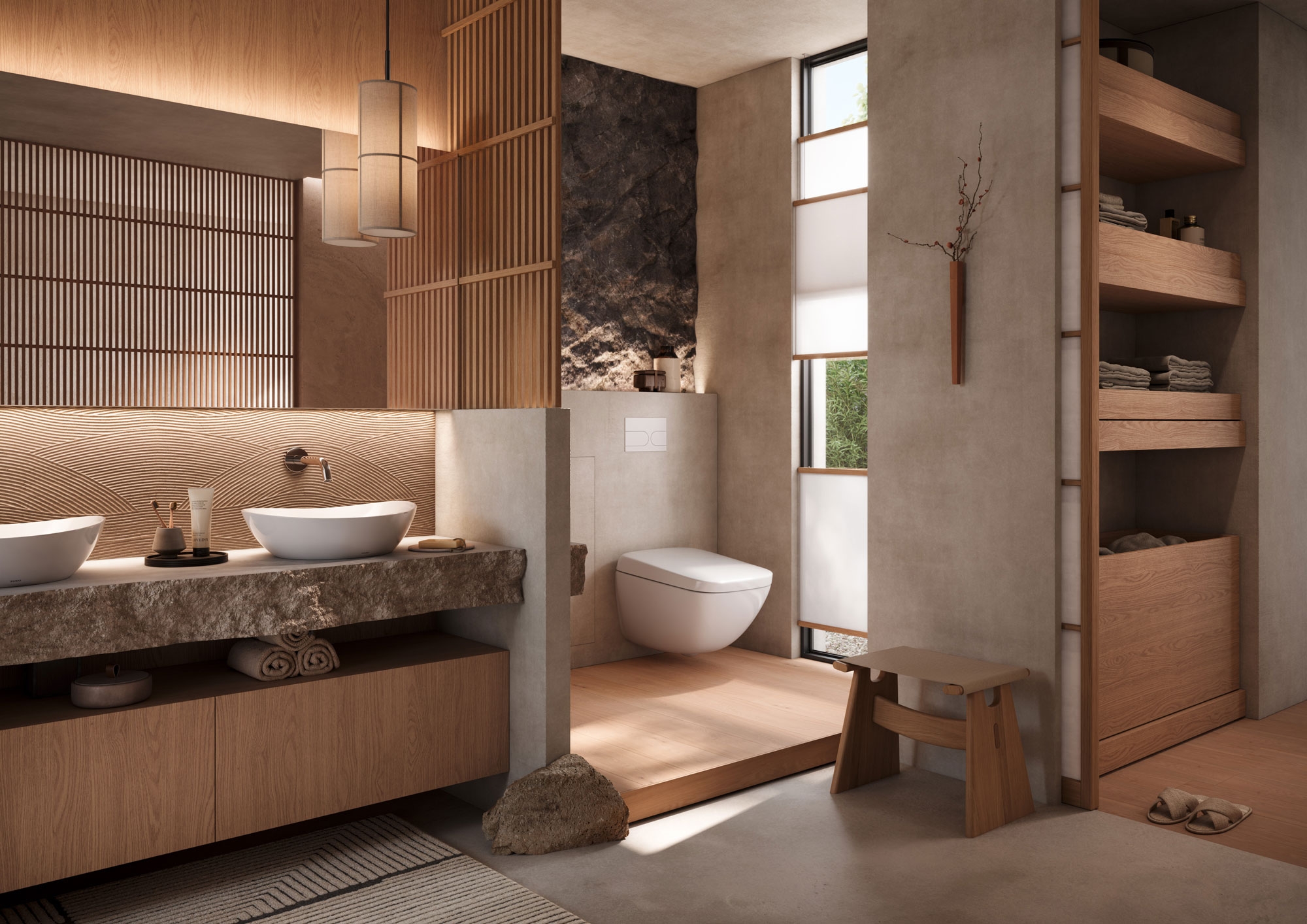
A vision of the modern Japanese bathroom: natural materials, flowing transitions and a clearly structured space. Concept: studio ukiyo in collaboration with TOTO. Photo: TOTO/studio ukiyo.
In this article
- Ma: the luxury of what is left out
- A threshold, not a door
- Materials that improve with age
- Wash first, bathe second: the Japanese ritual
- Why the bidet toilet is not a luxury in Japan
- Small rooms, large ideas
- Five rules from studio ukiyo
- Three questions for Flora Immler
- Japanese bathroom design: common questions
The room the West forgot
Travellers return from Japan with photographs of temples and ramen counters, and—almost invariably—a nagging memory of the bathrooms. The reaction is rarely about technology alone. It is about the discovery that a room dedicated to washing can be composed rather than merely plumbed: that lighting, proportion and material can be arranged so that a visitor's shoulders drop on entering.
That reaction is what TOTO, Japan’s leading sanitary manufacturer, set out to bottle. For its latest design concept the company worked with Flora Immler, founder of the studio ukiyo practice and a specialist in Japanese interiors, to ask a deliberately practical question: which qualities of the Japanese bathroom actually survive translation into a European home, at any budget and any floor area?
The answer, developed across a series of rooms photographed for the concept, is less a style guide than a set of priorities. Warm, natural tones. Indirect light. Materials that are honest about what they are. And, crucially, a willingness to leave things out.
“People should feel relaxed in the bathroom.”
— Flora Immler, founder, studio ukiyoMa: the luxury of what is left out
Western luxury tends to announce itself by addition—more brassware, more marble, more storage. The Japanese principle of ma proposes the opposite. Loosely translated as the beauty of intentionally empty space, ma treats the gap between objects as an active ingredient rather than a leftover. Ms Immler describes it as a governing influence on her work, noting that in Japan “empty space also serves a purpose”.
Applied to a bathroom, this has immediate consequences. Fewer, better fittings. Surfaces that are permitted to remain clear. Sanitaryware whose visual weight is managed rather than celebrated—which is precisely why TOTO’s designs tend to recede into the architecture instead of competing with it. The effect is not austerity. It is the sensation, familiar to anyone who has stayed at a good ryokan, that nothing in the room is asking for attention.
A threshold, not a door
The concept places unusual emphasis on arrival. In the studio ukiyo rooms, the entrance to the bathroom is treated as a transition to a different world rather than a change of floor covering: a narrowing, a shift in light temperature, a change of material underfoot. It is the architectural equivalent of lowering one’s voice.
Beyond the threshold, the main room opens generously to the outdoors. Natural light, soft shadow and a view of the garden bring the exterior inside, so that the atmosphere of the room changes over the course of the day rather than remaining fixed under a single ceiling fitting. Zones are marked with pedestals, alcoves and varied light temperatures instead of walls—a device that lends depth to rooms of any size.

Cosy alcoves, understated materials and careful lighting design bring an almost meditative atmosphere to the shower. Photo: TOTO/studio ukiyo.
Materials that improve with age
The palette is deliberately narrow and deliberately tactile: wood, natural stone, lime and clay plaster, with washi paper used to filter light and provide privacy. These are materials that record time rather than resisting it—a quietly radical choice in a room usually specified for wipe-clean perfection.
Contrast does the structural work. Warm timber against cool stone; a rough plaster wall against a precisely made ceramic basin; deep shadow against a single band of concealed light. In the concept’s washbasin area, asymmetrical TOTO TA Vessels sit on a heavy stone counter, their off-centre geometry supplying the one gesture of movement in an otherwise still composition. Ms Immler’s view is that it is “the carefully considered details that transform a space”—and the basin, the object most often touched in the room, is where that reasoning is easiest to test.
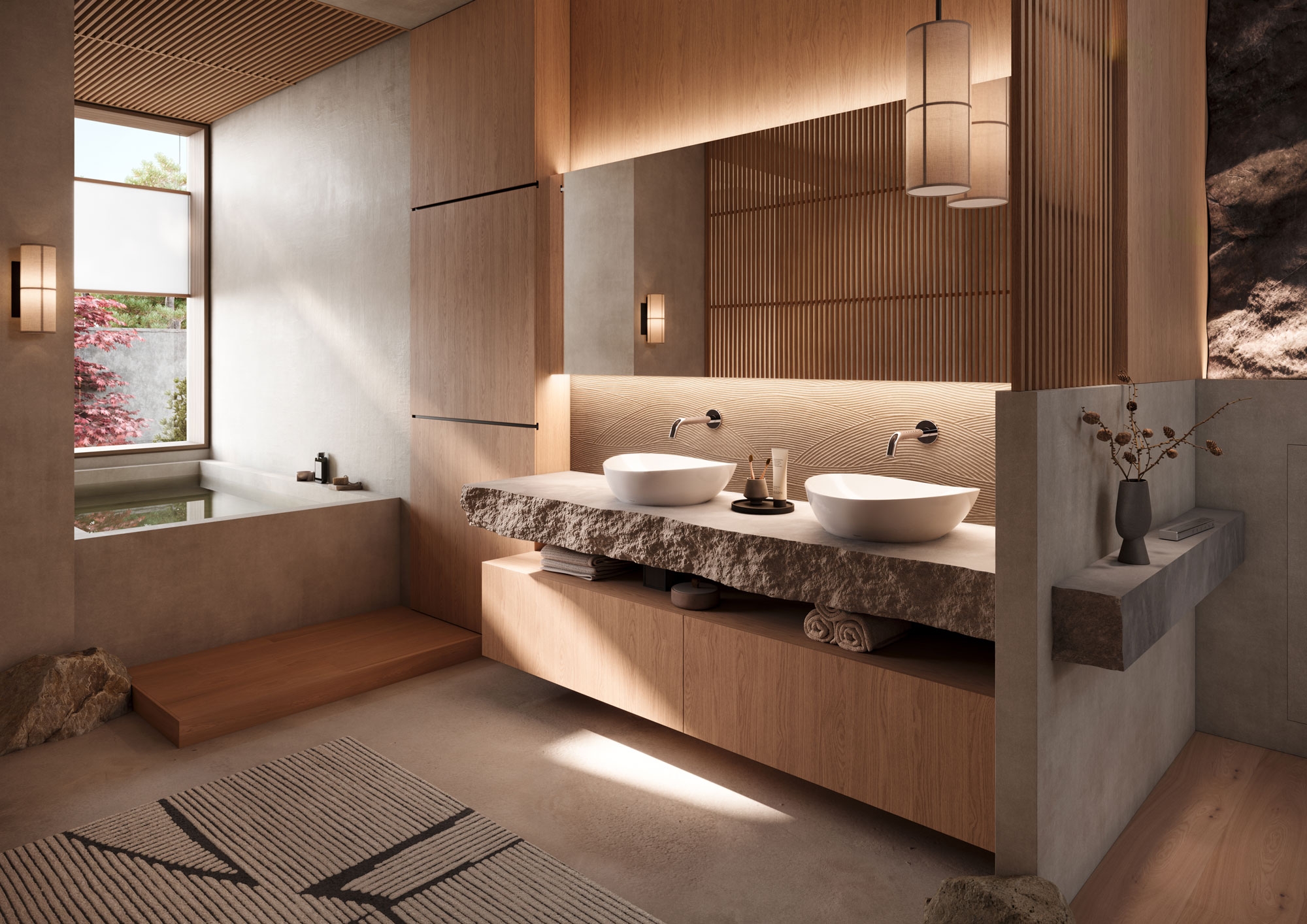
The asymmetrical TOTO TA Vessel washbasin: a single sculptural gesture within a restrained material palette. Photo: TOTO/studio ukiyo.
Wash first, bathe second: the Japanese ritual
Japanese bathing follows a sequence that inverts British habit. The body is cleaned first, in the shower. Only then does one enter the bath—which exists for rejuvenation rather than hygiene. The distinction sounds pedantic until one notices what it does to the room: the tub is freed from utility and becomes the centrepiece, a place for deliberate rest rather than a receptacle for soap. The tradition descends from the onsen and the public bathhouse, and it still governs how the modern Japanese bathroom is planned.
studio ukiyo’s concept imagines a streamlined, minimalist pool for this ritual. The engineering equivalent already exists. TOTO’s Zero Dimension bathing posture allows the body to relax completely, while the TOTO Flotation Tub uses specialised jets to deliver a massage that reaches the deepest muscle groups—a piece of hydrotherapy dressed as a sculpture. For a UK specifier, it is the single most persuasive argument that a bathroom can be a wellness space without a spa’s footprint.

The TOTO Flotation Tub: Zero Dimension comfort and deep-reaching massage jets, positioned as the heart of the room. Photo: TOTO/studio ukiyo.
Why the bidet toilet is not a luxury in Japan
Here the cultural gap is widest. In Japan the bidet toilet is ordinary domestic equipment: TOTO puts the proportion of Japanese homes fitted with one at roughly 75%, which makes it about as remarkable as a kitchen sink. Cleansing with warm, fresh water is simply how the job is done. Britain, meanwhile, has spent two centuries perfecting the paper alternative and calling it civilisation.
The WASHLET is TOTO’s answer, and more than 70 million have been sold worldwide. What makes it work in a designed room is restraint: like the rest of the range, it disappears into the architecture rather than advertising its electronics. Ms Immler is direct about the appeal of that approach, observing that TOTO’s products “focus on what’s absolutely essential”.
At the top of the range sits the NEOREST WX1 in matt white—an integrated shower toilet in which cistern, seat, cleansing wand, warm-air dryer and automatic flush are resolved into one continuous form. The matt finish is the significant detail for anyone working with lime plaster and unpolished stone: it absorbs light where a gloss glaze would bounce it, allowing the fitting to sit inside the material palette rather than on top of it.

The NEOREST WX1 in matt white: an integrated shower toilet designed to recede into the architecture. Photo: TOTO.
Small rooms, large ideas
The obvious objection to all of this is square footage. The average British bathroom is not a pavilion with a garden view; it is a boxroom with a window that opens onto a drainpipe. The concept’s most useful claim is that this matters less than one might assume.
Compact plans, Ms Immler argues, actually invite better decisions, because they force a designer to prioritise. Careful planning, intentional lighting and honest storage can manufacture a sense of space in a few square metres—and clear choices tend to produce calmer rooms than generous budgets spent indiscriminately. The measure of success is coherence: lighting, materials, proportion and layout working as one system rather than as five separate purchases.
Five rules from studio ukiyo
Ms Immler’s guidance for a Japanese-inspired bathroom, summarised for anyone briefing an architect—or a builder.
1. Streamline on purpose
A few carefully chosen elements produce a calmer, more spacious room than an accumulation of decorative detail.
2. Treat light as a material
Warm, indirect and dimmable lighting sets the atmosphere. Specify layers, not a single central fitting.
3. Combine natural materials
Wood, stone, clay and lime plaster make a bathroom feel warm and timeless. Where genuine materials are impossible, high-quality substitutes can still deliver calm.
4. Design the transitions
Use changes of material, pedestals, nooks and different colour temperatures to define zones and create depth—even in a small room.
5. Think holistically about comfort
The best rooms combine aesthetics, function and well-being. Fittings such as bidet toilets raise the everyday experience considerably.
Three questions for Flora Immler

Flora Immler, founder of studio ukiyo, developed the concept in collaboration with TOTO. Photo: BELLUCE.
What makes a Japanese-inspired bathroom distinctive?
Atmosphere, above all. A good bathroom communicates calm and comfort, and that comes from lighting, materials, proportion and the question of how a room feels to be in. Quality, in Ms Immler’s account, emerges from the interplay of every element rather than from individual highlights.
Can these principles work in a small bathroom?
Emphatically. Smaller rooms benefit most from decisive editing. Prioritise function, organise storage intelligently, and choose calm materials and lighting: limited space frequently inspires better solutions than an unlimited plan does.
What does authentic Japanese design mean to you?
Clarity, minimalism and material integrity—spaces built around people that generate a sense of calm. Ms Immler is candid that she is less interested in style than in how a room feels and what it contributes to daily life.

Japanese bathroom design: common questions
What is a Japanese-style bathroom?
A Japanese-style bathroom separates cleansing from soaking: the body is washed in the shower area first, then the bath is used for relaxation. Design-wise it favours natural materials, warm indirect lighting, clearly defined zones and a restrained number of fittings, with a bidet toilet (WASHLET) treated as standard equipment rather than a luxury.
What does “ma” mean in interior design?
Ma is the Japanese principle of intentionally empty space. Rather than filling a room, the designer uses the gaps between elements to create balance, calm and depth. In a bathroom it translates into clear surfaces, fewer fittings and generous negative space around each object.
Do I need a large bathroom to achieve this look?
No. The quality of the design matters more than the room size. Transitions, layered lighting and a disciplined material palette can create the sense of a retreat in a few square metres, and compact plans often benefit from the clearer decision-making they demand.
What is a WASHLET and how does it differ from a bidet?
A WASHLET is TOTO’s bidet toilet: a toilet or toilet seat with an integrated cleansing wand that washes with warm, fresh water, typically alongside a heated seat, adjustable spray settings and a warm-air dryer. Unlike a traditional standalone bidet, it requires no second fixture and no additional floor space.
Which TOTO products feature in the studio ukiyo concept?
The concept centres on TOTO’s WASHLET bidet toilets—represented at flagship level by the NEOREST WX1—the Flotation Tub with Zero Dimension bathing posture, and asymmetrical TA Vessel washbasins.
Can I install a TOTO WASHLET in the UK?
Yes. WASHLET models supplied by Tooaleta are WRAS approved for connection to the UK mains water supply. Installation requires a cold-water feed and a nearby fused electrical supply; our team can advise on the specification at the design stage, before first fix.
Where can I buy TOTO products in the UK?
Tooaleta has specified and supplied TOTO to UK residential, architectural and hospitality clients since 2011, with UK delivery, VAT-registered invoicing and specialist pre-sales advice on every model.
Specify the Concept
The products at the heart of TOTO’s Japanese bathroom concept are available for specification and delivery throughout the UK via Tooaleta.
- TOTO NEOREST® WX1 Matt White — The flagship integrated shower toilet, in the light-absorbing matt finish suited to natural material palettes.
- TOTO Flotation Tub (PJYD2200PWEE) — Freestanding massage bathtub with Zero Dimension posture and deep-reaching jets.
- TOTO TA Vessel Washbasin (L4704E) — The asymmetrical vessel basin specified in the studio ukiyo rooms.
- Browse the complete UK TOTO Collection — WASHLET, NEOREST, bathtubs and ceramics, delivered across the UK.
Design Your Own Retreat
Tooaleta has been specifying and supplying TOTO to UK homes, architects and hospitality projects since 2011. Talk to our specialists about the right WASHLET, tub or basin for your room—before the tiles go on.
Shop TOTO Washlets Speak to a Specialist


