


The Tokyo Toilet Project & The Washlet Revolution
3/24/2026How Japan Taught the World to Respect the Public Toilet
Thirteen of the world's most celebrated architects were handed an unusual brief: transform a facility associated with neglect, crime and embarrassment into a monument of civic pride. What emerged from the Tokyo Toilet Project reveals as much about contemporary Japan as it does about the future of urban hygiene—and at the quiet heart of every installation sits a single piece of technology that makes the difference.
TOKYO | SHIBUYA WARD
There is a kind of architecture that polite society pretends not to notice. The public lavatory—functional, unglamorous, often frightening—has for generations occupied the lowest rung of civic infrastructure. In most of the world's cities, the public toilet is a facility of last resort: poorly lit, difficult to locate and maintained with the bare minimum of civic conscience. It attracts the unwanted and repels the very people it is meant to serve. Architects of ambition ignore it. City planners tolerate it. Citizens endure it.
Japan, as it has done in so many domains of daily life, chose to treat this problem differently. In 2020, the Nippon Foundation launched what it called the Tokyo Toilet Project: a commission to seventeen designers and architects—some of the most distinguished practitioners alive—to redesign seventeen public lavatories across the Shibuya Ward of Tokyo. The sites were scattered through parks, beside railway stations, along greenways and in quiet residential streets. Each designer was given essentially complete creative freedom. The only constant, installed in every facility without exception, was the product that Japan has quietly come to regard as a national standard: the TOTO WASHLET.
The results, now complete and in use by the citizens of Shibuya, amount to something that has no obvious parallel in the history of urban sanitation: a curated collection of small public buildings, each one a genuine work of architecture, each one anchored by a washlet unit whose sensor-operated wand, heated seat and warm-water cleansing function have rendered the conventional toilet paper a relic of an earlier age. To examine these installations one by one is to understand both why Japan produces so little urban squalor and why the rest of the world, slowly and somewhat reluctantly, has begun to pay attention.
Glass houses and the politics of safety
Shigeru Ban · Haru-no-Ogawa Community Park & Yoyogi Fukamachi Mini ParkNo designer addressed the latent fear surrounding public lavatories more directly than Shigeru Ban, the Pritzker Prize-winning architect whose career has been defined by unconventional materials and a restless social conscience. Ban's contribution to the project—two identical installations in Haru-no-Ogawa Community Park and Yoyogi Fukamachi Mini Park—resolved the problem of public anxiety with an act of radical transparency. Literally.
 Shigeru Ban's transparent toilet structures at Haru-no-Ogawa Community Park. By day, passers-by can verify at a glance that no one is hidden inside—and that the facility is clean.
Ban's twin structures are fabricated from glass panels that, when unoccupied, are entirely transparent. The interior—the washlet unit, the changing area, every fixture—is fully visible from the park outside. Only when a user locks the door does an electrical current cause the glass to frost, granting the privacy the moment demands. The logic is elegant and irreducible: the two greatest concerns that deter people from using a public lavatory are the fear that someone is hiding inside and the suspicion that it will be filthy. Ban addressed both with a single material decision.


 The interior layout places the washlet within a bright, uncluttered space. A dedicated changing area accommodates the full range of users the Tokyo Toilet Project set out to serve.
 Clear, universal accessibility markings ensure the facility communicates inclusivity before a visitor even approaches the door—a detail that no amount of architectural ambition can substitute for.
 Shigeru Ban, whose use of transparency transformed the public lavatory's relationship with the city around it.
Ban was deliberate, too, in departing from the conventional colour coding of red for women and blue for men. The Haru-no-Ogawa installation uses a cooler palette; its twin in Yoyogi Fukamachi opts for warmer tones. It is a small gesture, but a pointed one in a project whose stated aim is to design facilities that serve everyone without discrimination. At night, illuminated from within, both structures glow in their respective hues like paper lanterns—beautiful objects that happen also to be lavatories.
Illumination as civic duty
Takenosuke Sakakura · Nishihara Itchome ParkIf Ban's solution was transparency, Takenosuke Sakakura's was luminescence. When Sakakura first visited Nishihara Itchome Park, he found a space with what he described as a "uniquely dark and lonely atmosphere"—precisely the conditions under which public lavatories become dangerous and underused. His response was to design a facility that functioned less as a building than as a lantern: a glowing rectangular volume whose purpose was to light the park itself.


 The interior of the Andon Toilet: a high ceiling, glass outer walls that reflect the surrounding trees and, at its centre, the TOTO WASHLET—the technological constant that unites every installation in the project.
 Takenosuke Sakakura, who approached the public lavatory as a problem of civic light rather than civic engineering.
The building's simple rectangular form was deliberate. Sakakura and his team rejected any decorative flourish that might compromise the central objective: maximum brightness within a minimal footprint. Transparent outer walls allow daylight to filter through surrounding trees, dappling the interior and preventing the claustrophobic enclosure that makes so many public lavatories feel threatening. The high ceiling reinforces this generosity of space. The facility becomes, in Sakakura's terms, as open and bright as possible within its limited constraints—a description that applies equally well to the washlet unit at its heart, which brings warmth, cleanliness and a degree of private comfort that the architecture alone cannot provide.
Toyo Ito · Yoyogi-Hachiman ShrineAt the Yoyogi-Hachiman Shrine, Toyo Ito arrived at a similar conclusion by a different path. A Pritzker laureate whose career spans five decades of formal experimentation, Ito was instructed by the project to focus on a specific and underserved constituency: women using public lavatories alone at night. His solution—three separate organic structures whose mushroom-like silhouettes emerge from a backdrop of shrine forest—prioritises unobstructed sightlines above all else. There are no hidden corners, no dead ends, no dark alcoves. Each of the three buildings contains all the functions of an accessible toilet, meaning the facility is simultaneously generous to the able-bodied and properly equipped for those with mobility needs.


 Toyo Ito, whose organic structures at Yoyogi-Hachiman Shrine were designed with a specific user in mind—a woman, alone, at night.
Art installations that happen to flush
Tomohito Ushiro · "Monumentum", Hiroo Higashi ParkAmong the more conceptually ambitious contributions to the project is Tomohito Ushiro's "Monumentum" in Hiroo Higashi Park—a facility that occupies the intersection of public art and sanitary infrastructure so completely that early visitors reportedly mistook it for a small contemporary art museum. This is, it turns out, precisely the point. Ushiro's thesis is that people treat public art differently from public lavatories: with more care, more respect, more consideration. By making the two things indistinguishable, he invites users to bring the same reverence they would bring to a gallery to the quotidian act of using a public convenience.
 "Monumentum" in Hiroo Higashi Park, with the University of the Sacred Heart campus in the background. The facility communicates gently with passers-by—more art installation than public amenity in its outward aspect.


 Tomohito Ushiro's central argument: that the same social psychology that protects public art can be deployed to protect public lavatories.
Ushiro integrated a lighting system of extraordinary complexity into the structure—7.9 billion distinct patterns, the same number as the world's human population. The system projects shifting patterns reminiscent of filtered sunlight, moonlight through leaves and, at night, the gentle pulse of fireflies. The effect is poetic in intention, scientific in execution: a reminder that the Tokyo Toilet Project, at every level, sought to deploy technological sophistication in the service of human comfort. The washlet unit within—sensor-operated, touch-free from entry to exit where desired—belongs to exactly that tradition.
Kazoo Sato · "Hi Toilet", Nanago Dori ParkIf Ushiro's facility represents technology in service of art, Kazoo Sato's "Hi Toilet" in Nanago Dori Park represents technology for its own rigorous sake. Sato's design brief was precise: to create the most hygienic public toilet in the world. His research, drawn from studies of lavatory behaviour across Europe and the United States, identified a single consistent finding—a high proportion of users consciously avoid touching any surface with their hands. The washlet's warm-water cleansing function already addresses much of this concern; Sato extended the logic to every other interaction in the facility.
 The "Hi Toilet" in Nanago Dori Park: a pure white globe four metres high, whose shape promotes natural ventilation and prevents the accumulation of odours.


 Kazoo Sato, who set himself the task of designing the world's most hygienic public toilet—and arguably succeeded.
The "Hi Toilet" accepts voice commands in Japanese and English: "open the door", "flush the toilet", "play music". Users need touch nothing unless they choose to. The spherical structure—pure white, four metres high at its apex—was chosen because a sphere, unlike a box, has no corners where air can stagnate. A 24-hour ventilation system combines natural air supply with machine-driven exhaust. It is a facility of almost intimidating cleanliness, one in which the washlet's warm-water function feels not like a luxury but like the only rational conclusion to a building designed entirely around the elimination of contact-transmitted contamination.
Warm-Water Cleansing
Every Tokyo Toilet Project installation features the TOTO WASHLET's sensor-operated wand—delivering warm water in place of paper and raising the bar for public hygiene permanently.
Heated Seat & Drying
A heated seat and warm air dryer ensure the experience is as comfortable in a public park as in a private home—the standard Japan no longer considers exceptional.
Touch-Free Operation
Sensor-activated lids and flush mean users need touch nothing if they prefer not to—a feature that predated the hygiene awareness of 2020 by more than a decade.
Nature, material and the long view
Kengo Kuma · "A Walk in the Woods", Nabeshima Shoto ParkNot every contribution to the project reached for technology as its primary language. Kengo Kuma—whose Studio has become one of the world's most prolific producers of wood-and-nature architecture—approached his commission in Nabeshima Shoto Park with the conviction that the best public lavatory would be one that appeared not to be a public lavatory at all, but a natural extension of the parkland around it.
 Kengo Kuma's "A Walk in the Woods": five separate cedar-clad huts connected by a forest path running along the park's natural slope. The installation reads less as a building than as a found element of the landscape.

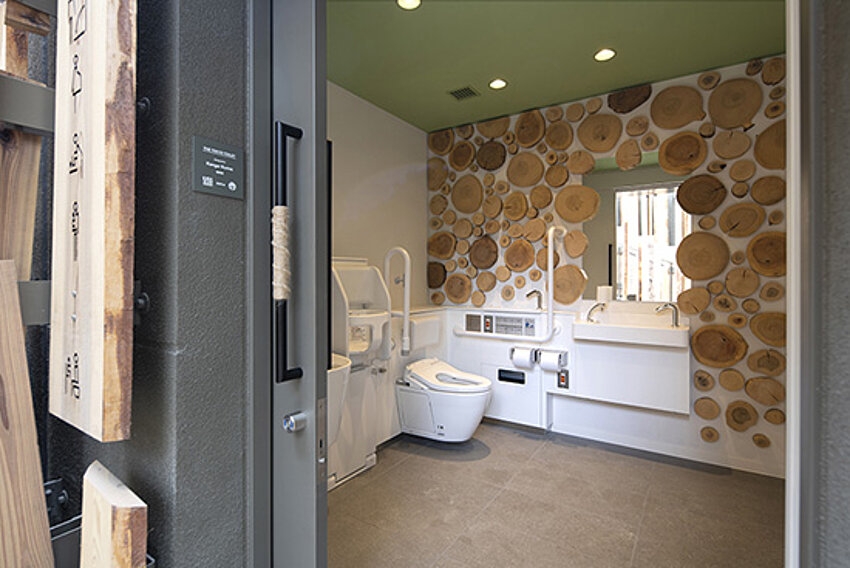
 Kengo Kuma, who divided the conventional single block into five separate huts—creating what he termed a "public toilet village", open, breezy and easy to pass through.
Kuma divided the conventional single-block lavatory into five discrete huts, connected by a pathway that runs along the park's existing slope. The exteriors are clad in louvres of eared Yoshino cedar—a material that breathes, weathers and, over time, deepens in colour and character. Inside each hut, the washlet performs its function with the same unobtrusive efficiency as in every other Tokyo Toilet installation: heated seat, warm-water wand, gentle air drying—amenities that, in Japan, are considered no more remarkable than a light switch, but that visitors from abroad tend to regard with a mixture of surprise and immediate conversion. The tension between Kuma's ancient material and this contemporary fixture is productive rather than awkward; both are, in their respective ways, distinctly and irreducibly Japanese.
Kashiwa Sato · "WHITE", Ebisu Station West ExitAt the Ebisu Station West Exit—a site of relentless daily footfall—Kashiwa Sato made a decision that, in retrospect, feels obvious and yet must have required a certain courage: he made everything white. In a project in which every other designer reached for a distinct formal or material gesture, Sato chose the absence of gesture. "WHITE" is, by design, unremarkable from a distance. It blends into the station's surroundings with a calculated unobtrusiveness that is itself a kind of statement: a public lavatory should not have to shout to earn its place in the city.


The building's white louvred façade performs several functions simultaneously. It provides privacy for users inside without requiring opaque walls. It ventilates the interior. It brightens the atmosphere of the station approach. And it communicates, in the simplest possible visual shorthand, the idea of cleanliness—which is, Sato argued, the single most important quality a public lavatory can project before a visitor even opens the door. The pure white washlet within completes the message. Cleanliness, here, is both an aesthetic choice and a functional reality.
Humour, legibility and the pavilion principle
Fumihiko Maki · "Squid Toilet", Ebisu East ParkEbisu East Park, a few hundred metres from Sato's austere installation, contains one of the project's most immediately joyful contributions. Fumihiko Maki—one of Japan's most celebrated architects and a Pritzker laureate—brought to his commission two qualities that are rarely associated with public sanitation: freshness and humour. "Fresh", for Maki, means open, bright, hygienic. "Humorous" means a place where the act of using a public lavatory can involve a moment of relaxation and even pleasure.
 The "Squid Toilet" at Ebisu East Park, seen from across the park: its roof—which integrates separate sections into a single expressive form—gives the facility its nickname and its distinctive silhouette.


 Fumihiko Maki, who approached the public lavatory as an opportunity to demonstrate how architecture can make people happy—a claim that, standing inside his Ebisu East Park installation, is difficult to dispute.
Maki's decentralised layout—separate units arranged around a central courtyard open to the park's greenery—achieves multiple objectives simultaneously. It eliminates blind spots and hidden corners, making the facility feel safe. It allows natural light and ventilation to penetrate every section. And it creates what Maki calls a "park pavilion with a rest area"—a space that functions as a public lavatory but reads as something rather more generous than that. A bench outside the universal toilet, where a companion might wait or a tired commuter might sit, turns the facility into a minor civic amenity. Architecture, Maki noted, remains in place for a very long time. It ought, therefore, to be designed as a social asset: a contribution to the city rather than a concession to its baser necessities.
Memory, identity and the comfort of the familiar
NIGO® · "THE HOUSE", JingumaeIn Jingumae—the heart of Harajuku, Tokyo's most culturally layered neighbourhood—the fashion designer and cultural polymath known as NIGO® approached his commission with a question: what does it feel like to be genuinely at home? His answer took the form of a building that resembles, with near-total literalism, a modest American house of the mid-twentieth century: pitched roof, garden fence, doors that open inward so they always appear welcoming. "THE HOUSE" is a deliberate anachronism, a fragment of architectural memory transplanted into one of Tokyo's most self-consciously contemporary streetscapes.
 "THE HOUSE" in Jingumae: an architectural quotation from Washington Heights, the American military housing area that once occupied the site of Yoyogi Park and whose influence on postwar Harajuku culture has never fully dissipated.


 NIGO®, who looked to architectural history rather than formal innovation to find a way of making the public lavatory feel welcoming.
The reference is specific and historically grounded. Washington Heights—the housing area built in 1946 for families of American military personnel on the site that would become Yoyogi Park—was the catalyst for Harajuku's transformation into a cultural centre. Its domestic architecture, almost entirely demolished, left an invisible imprint on the neighbourhood's identity. NIGO®'s facility preserves that imprint in physical form: a duplicate of a vanished house, now repurposed as a public convenience whose contactless faucets, large sink area and TOTO WASHLET bring it squarely into the twenty-first century beneath its nostalgic exterior. The building proves that familiarity can be as effective as innovation in making people feel that a public space belongs to them.
Miles Pennington · "…With Toilet", HatagayaMiles Pennington of the UTokyo DLX Design Lab brought a designer's rigour and an academic's methodology to his Hatagaya commission. Before settling on a form, Pennington and his team ran workshops drawing participants of multiple nationalities, ages and genders, then collaborated with architectural specialists to convert those findings into a building. The result, "…With Toilet", is the project's most explicitly programmatic contribution: a multi-function public structure that adds a community space—an exhibition area, an information centre, a bench whose 31 adjustable posts allow it to reconfigure for different purposes—to the lavatory facilities at its core.
 The Hatagaya installation: a triangular plan that places the toilet stalls in three corners while offering a fourth, shared space that can serve as an exhibition area, community hub or simply a place to wait in comfort.


 Clear accessibility markings on the Hatagaya installation. The project's consistent attention to inclusive signage reflects a brief that required every facility to serve every user.
The "…With Toilet" thesis is straightforward: a public lavatory that offers more than a public lavatory is used more than a public lavatory. Frequency of use generates social oversight; social oversight discourages the vandalism and neglect that render most public conveniences unusable within months of their installation. Pennington's design is, in this sense, a sociological intervention dressed as an architectural one. By giving the building a reason to be visited, he gave it a reason to be maintained. The washlet units in the three stalls provide the hygienic core around which everything else is arranged—the reliable, consistent centrepiece that the community hub exists to protect.
Junko Kobayashi · "Toilet of Town Lights", Sasazuka GreenwayOn the Sasazuka Greenway—a pedestrian route threading beneath the Keio train line, constrained by buried pillars and a water main—Junko Kobayashi arrived at her building's form through a process she describes as collaborative accident. The material was determined by necessity: COR-TEN steel, a weathering alloy that could be assembled without heavy machinery and whose panels could be shaped into curves. When Kobayashi and her team began assembling the structure according to their original flat plan, something unexpected happened. A shape emerged that reminded everyone present of a fairy tale.
 The "Toilet of Town Lights" on the Sasazuka Greenway: COR-TEN steel panels, chosen for structural necessity, produced a form that has been compared variously to a fairy-tale cottage and a piece of sculptural furniture for the street.


The yellow circular eave above the structure, which residents have taken to calling the moon, is complemented by rabbit illustrations peeking from the windows: the work of graphic designer Tetsuya Ota, chosen in part because the local preschool's walking route passes directly alongside. Kobayashi has been designing lavatories for several decades. She is perhaps uniquely qualified to observe that the true test of a public toilet's design comes not in its first year but in its thirtieth. The COR-TEN steel panels were deliberately pre-weathered before installation: the rust that will develop over time is not decay but design, a deepening of colour and character that will, Kobayashi believes, cause the facility to blend ever more naturally into its urban surroundings. The washlet inside, meanwhile, operates by the same reliable logic it employed on the day the building opened—unaffected by the aesthetic transformations playing out on the exterior.
The politics of the personal: safety, identity and material memory
Nao Tamura · Higashi SanchomeNao Tamura's commission—a triangular plot in Higashi Sanchome, Shibuya—produced one of the project's most quietly radical statements. Tamura, a New York-based designer, brought to her brief a perspective shaped by years of observing the LGBTQ+ community navigating a city in which public spaces still frequently fail to accommodate the full spectrum of identity. Her facility provides three entirely separate, self-contained rooms—not gender-coded, not hierarchically arranged, but simply three equally dignified spaces in which anyone, regardless of age, identity or ability, might answer a need that is common to all of us.
 Nao Tamura's Higashi Sanchome installation: red steel panels folded like origata paper, creating a geometric structure whose colour—chosen to deter impulsive crime and reassure users who might otherwise feel unsafe—makes an implicit argument about the relationship between design and personal safety.


The formal language Tamura chose was origata—the traditional Japanese method of folding paper that underlies origami. Thin metal panels are folded to create the impression of wrapped paper: pure, respectful, ceremonially clean. The colour red was not a decorative choice but a considered one. Red, in a disorienting or threatening environment, signals clearly and commands attention. Tamura observed that lavatories are, statistically, locations where crimes occur; her red facility announces its presence to the street and, she believes, deters impulsive wrongdoing by making the act of entering visible. Safety, here, is not a byproduct of the architecture—it is the architecture's primary ambition.
Marc Newson · Urasando
The final installation considered here—and perhaps the one that most clearly demonstrates the range of creative intelligence the project assembled—is Marc Newson's contribution in Urasando. Newson is among the most celebrated industrial designers alive, a practitioner whose career encompasses aircraft cabins, furniture, timepieces and consumer electronics. He was not an obvious choice for a public lavatory. But the brief, as he noted when reflecting on the commission, was not unlike designing a product. A limited, complex space. A concentration of technological elements. A specific and unambiguous purpose. The analogy he reached for was the aircraft cabin: all the functions of a modern life compressed into the smallest possible envelope.
 Marc Newson's Urasando installation: reinforced concrete walls, a Minoko copper roof and a stone wall border. A building conceived on the timescale of a monument rather than a convenience.


 Marc Newson, who brought the vocabulary of product design—precision, material integrity, the long view—to a public lavatory beside a highway.
The exterior materials were chosen with a deliberately long temporal horizon in mind. The main structure is reinforced concrete—refined and precisely placed in the manner unique to Japanese construction, a material whose possibilities Newson has observed nowhere else in the world being exploited so fully. The Minoko copper roof references a craft tradition that has drawn Newson back to Japan across decades: copper ages magnificently, developing the deep oxidised patina that transforms a surface from mere cladding into something resembling antique material. The stone wall at the base completes the composition. Newson believes that in time the Urasando installation will come to look like a small monument—a description that, on a site complicated by uneven topography and the expressway roaring above it, represents a significant architectural achievement. The interior, by contrast, is seamless and monochrome, in a green that Newson cites as among his personal favourites: serene, hygienic, quietly luxurious in the way that only well-executed simplicity can be. Within it sits the washlet, as it does in every installation across the project—consistent, warm, unassuming and, by any objective measure, the most sophisticated piece of equipment in the room.
The quiet revolution at the centre of things
The Tokyo Toilet Project has been described, variously, as a public art initiative, a demonstration of what civic infrastructure can aspire to and a monument to Japanese perfectionism. It is all of these things. But examined closely—installation by installation, fixture by fixture—it is also something more specific: a demonstration of what happens when a society decides that personal hygiene is a public value, not a private embarrassment, and invests accordingly.
What every one of these thirteen buildings shares—regardless of whether its designer reached for transparency or opacity, copper or cedar, fairy-tale curves or glacial minimalism—is a TOTO WASHLET at its operational core. This is not incidental. The washlet is the product through which Japan first articulated its belief that the act of personal cleansing, in a public setting, deserves the same thoughtfulness that goes into any other element of the built environment. Its sensor-operated lid, its heated seat, its warm-water wand and its gentle drying function perform the same quiet service in Toyo Ito's mushroom structures at Yoyogi-Hachiman as in Marc Newson's concrete-and-copper monument in Urasando, in Shigeru Ban's transparent glass pavilions in Tomigaya as in Kazoo Sato's voice-controlled white sphere in Nanago Dori Park. The architecture changes; the standard of personal care does not.
The lesson that the Tokyo Toilet Project offers to the rest of the world is both architectural and philosophical. It is possible to build public lavatories that people want to visit. It is possible to make facilities of genuine hygiene and comfort available to every citizen of a city, regardless of their means. But the prerequisite is a willingness to regard the public lavatory as something worth caring about—as a piece of infrastructure that reflects, in small but telling ways, what a society thinks of the people who use it. Japan has answered that question, for now, with thirteen remarkable small buildings and the fixture that makes them, in the most fundamental sense, work.


